Every 3 seconds, someone in the world develops dementia. Every day, thousands of people across the GCC wake up with tremors, memory loss, or weakening muscles and have no idea why. They will spend months, sometimes years, moving through expensive specialist referrals, MRI machines, and hospital waiting lists before anyone gives them a diagnosis. By the time that word arrives, the disease has already advanced. Treatment windows have closed. Years of life have been lost, not to the disease itself, but to the wait.
This is the problem NeuroPen solves.
Neurodegenerative diseases, including Parkinson's, Alzheimer's, ALS, Multiple Sclerosis, and Dementia, affect over 50 million people worldwide, with millions more across the GCC. These conditions are progressive and irreversible. Early detection is the single most powerful tool clinicians have. Yet the current diagnostic pathway is broken: it is costly, slow, invasive, and entirely inaccessible at the point of care. There is no clinical-grade, portable tool that a doctor can use in a standard clinic appointment to screen for these conditions in real time. Patients wait. Diseases advance. Healthcare systems absorb the cost of late-stage intervention that could have been avoided.
The deeper problem is biological. Neurodegenerative diseases leave physical traces in motor behavior long before symptoms become visible. A
Parkinson's patient's handwriting changes, letters shrink, pressure weakens, tremor appears in the 3 to 8 hertz frequency band, years before diagnosis. An Alzheimer's patient struggles to place numbers correctly on a clock face. An ALS patient's grip collapses under sustained writing. These signals exist. They are measurable. Neurologists know them. But clinicians have no objective, trackable tools to capture them at the point of care. There is no affordable, portable device that can objectively capture neurological function in real time, across multiple disease types, in any clinical setting. Until now.
This gap does not only harm patients. It creates a systemic burden on the UAE and GCC healthcare system, driving up long-term treatment costs, increasing specialist dependency, and delaying the kind of early intervention that the UAE's vision for AI-driven healthcare is designed to enable.
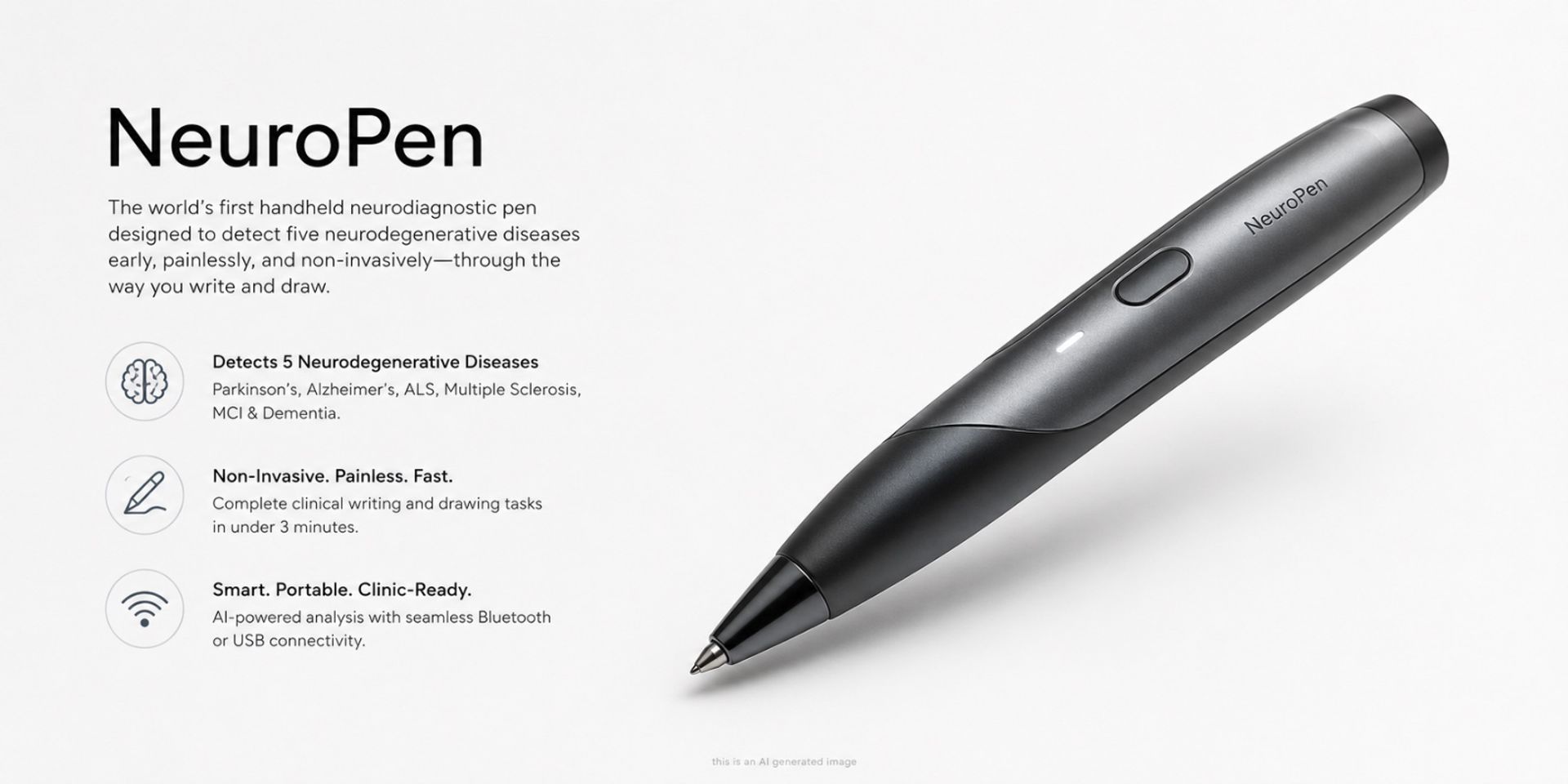
NeuroPen closes this gap. It transforms an ordinary writing task into a clinical diagnostic event, capturing the neurological fingerprint hidden in how a person writes and draws, and delivering an objective, real-time biomarker report in under three minutes. No needles. No machines. No waiting rooms.
The problem is urgent. The technology to solve it exists. NeuroPen combines them for the first time.